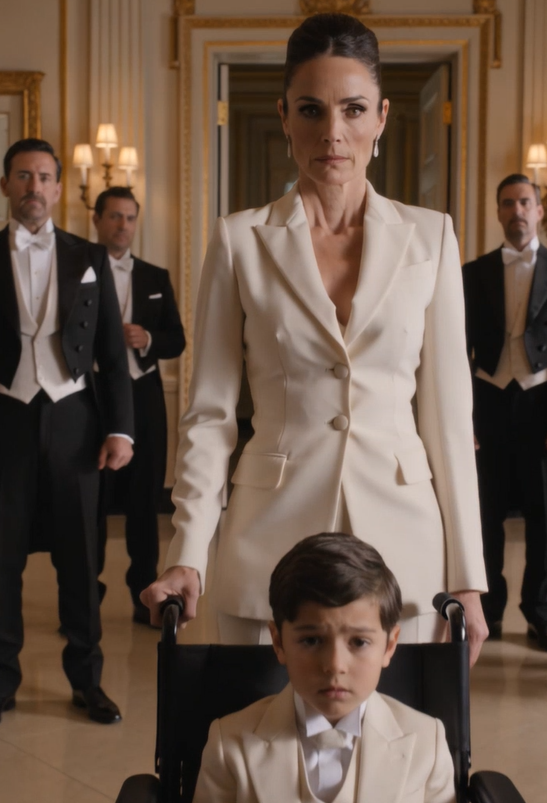
The ballroom was flawless until the girl entered. Beneath the glow of crystal chandeliers, wealthy guests moved through the evening like part of the décor itself — polished, composed, and wrapped in a silence that belonged to power. Champagne shimmered in crystal glasses, pale gowns swept across the marble floor, and every smile looked practiced enough to survive any scandal. At the center of it all sat a boy in a wheelchair, dressed in a pale suit that made him look even more fragile beneath the golden light. Behind him stood an elegant woman in white, one hand resting on the chair as if she were not simply guiding him but guarding him. No one expected the interruption. No one expected the child in the plain white dress who stepped into that perfect room as though she had every right to be there. She did not hesitate. She did not lower her eyes. She walked straight through the silence, raised her hand toward the boy, and said, with a calmness that unsettled everyone who heard it, “I came for him.”
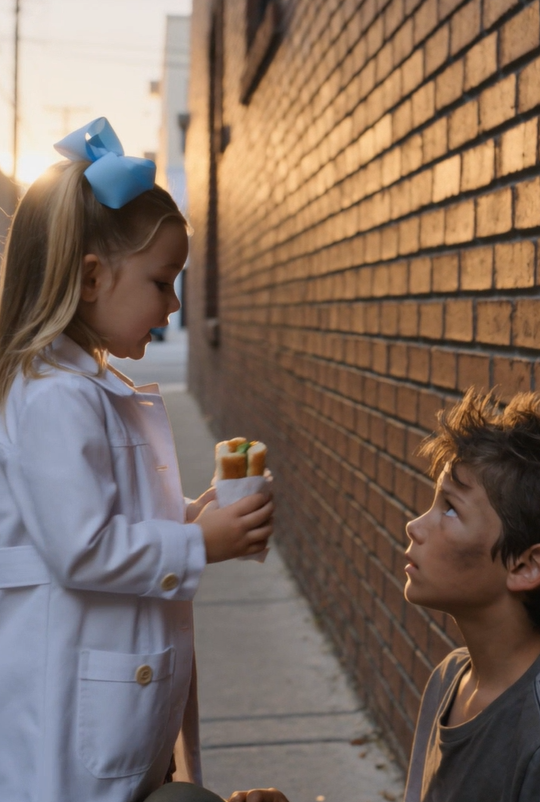
The air changed instantly. Conversations died before they could fully stop. A violinist near the edge of the room froze in place. Several guests turned with that polite confusion reserved for things they assumed would be quickly handled. The woman in white moved first. Her shoulders stiffened, and her fingers tightened around the wheelchair handle just enough for the nearest people to notice. She stepped slightly forward, placing herself between the girl and the boy without making the movement obvious. “You shouldn’t be here,” she said, her voice controlled, soft, and sharp enough to cut. But the girl did not flinch. Her dark hair was neatly pulled back, her expression serious, almost too serious for someone so young. She did not look frightened by the room, the guests, or the woman standing in front of her. “I wasn’t asking,” she replied. A murmur passed through the crowd like a ripple through glass. It was not just what she said. It was the way she said it — with certainty, as if she had crossed a very long distance to stand exactly there, exactly now.
The boy in the wheelchair had been silent the whole time, but now he leaned forward slightly, his eyes fixed on the girl’s face. Until that moment, he had looked confused more than anything else, like someone being drawn into a scene he did not understand. But now something else appeared in his expression — not recognition yet, but the beginning of it, like a shadow rising under water. The woman noticed. Her calm slipped for the first time. “Wait,” she said quickly, too quickly. “You don’t know her.” It sounded less like reassurance and more like a warning. Then the room went still in a deeper way, because the girl never took her eyes off the boy and answered with a quiet certainty that made several guests visibly tense. “He does.” The words landed harder than they should have. The boy’s face changed. He stared at her as if trying to force a locked door open somewhere deep inside himself. Then, almost under his breath, he whispered, “…It’s you.”
That was the moment the room understood that this was not a child’s mistake. This was memory. The woman in white went pale beneath her perfect composure. Her mouth parted, but no sound came immediately. The guests looked from the girl to the boy and back again, sensing a truth they had not been invited to witness. The girl took one step closer, and the movement was so small, so controlled, that it became impossible to ignore. She extended her hand toward him fully now, not like someone making a dramatic gesture, but like someone finishing a promise. “Stand up,” she said. The words should have sounded impossible. They should have sounded childish, cruel, absurd. Instead, they fell into the room with the weight of something long delayed. The woman stepped forward at once, panic finally breaking through the elegance she had worn all evening. “No,” she said sharply. And in that single word there was too much fear — not fear for the boy, but fear of what might happen next.
Too late. Because something had already shifted in him. The boy’s breathing changed. His hands, which had rested motionless in his lap, tightened against the arms of the wheelchair. His eyes never left the girl’s face. It was as if her presence had reached into some hidden part of him that years of doctors, silence, and careful explanations had never touched. Around them, the ballroom stood frozen — crystal, marble, silk, and wealth reduced to a silent audience. The woman’s control was gone now; everyone could see it. She reached toward the boy as if to stop him, but even she seemed to understand that the moment no longer belonged to her. Then, just as the boy shifted forward and the first hint of movement ran through his body, a voice broke from the crowd — trembling, stunned, disbelieving. “She’s the girl from the fire.” No one breathed. Because suddenly the perfect room was no longer hosting a celebration. It was witnessing the return of something buried — and the child no one knew had just walked in carrying the one thing powerful enough to bring it back.