The Little Girl Hugged the Homeless Boy in the Alley—Then He Looked at Her Mother and Whispered, “Mom?”
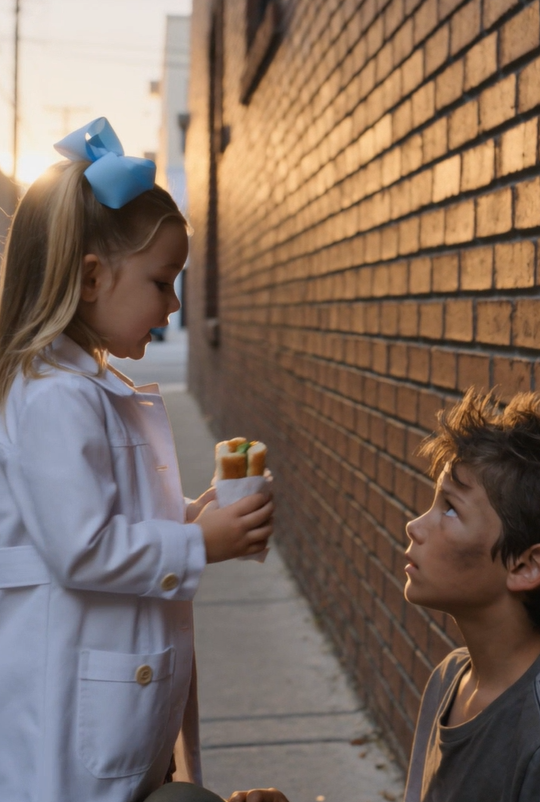
The narrow city alley glowed in the last light of sunset, its long red brick wall washed in warm gold and deep shadow. Dust floated lazily in the air, and the distant hum of the city barely reached that forgotten place. People passed the alley every day without slowing down, without looking, without wondering who might be sitting there in silence. Against the wall, half hidden by shadow, sat a thin homeless boy with messy brown hair and dirt on his face, his knees pulled close to his chest as though he were trying to disappear into the bricks behind him. His gray shirt was worn nearly white in places, and his eyes held the kind of guarded emptiness no child should ever carry. Adults glanced away from him. Teenagers pretended not to see him. Even those who noticed him only walked faster. But one small blonde girl in a white coat stopped the moment she saw him. A pale blue bow held back her soft hair, and in her hands she carried a sandwich wrapped in white paper — the lunch she had saved. She looked at the boy not with fear, not with pity, but with a kind of quiet certainty, as if kindness to him were the most natural thing in the world.
She walked straight toward him while the evening light glowed behind her like a halo. The boy lifted his head slowly, confused that anyone — especially a little girl — would come closer instead of turning away. She stood in front of him, held out the sandwich with both hands, and said gently, “Here, take it.” For a second he did not move, as if he had forgotten how to trust a good thing. Then his dirty fingers reached out carefully, almost apologetically, and took the sandwich from her. His lips trembled. “Thank you,” he whispered, his voice so quiet it seemed carried more by pain than by sound. The girl smiled at him, not the nervous smile of a child doing something brave, but the warm smile of someone who had already decided he mattered. Then she did something no one passing that alley could have imagined. She stepped closer, bent down, and wrapped her little arms around him. The boy froze completely. Hunger had touched him. Cold had touched him. Cruelty had touched him. But kindness like this had not. For one stunned second, he did not know what to do with it.
That was the exact moment the woman appeared at the far end of the alley. Blonde, breathless, wearing a beige trench coat and heels not meant for running, she came around the corner as if she had been searching for something — or someone — with desperate urgency. When she saw her daughter hugging the homeless boy, panic hit her instantly. “No! Get away from him!” she shouted, her voice sharp with fear as she hurried forward. The little girl flinched and turned, surprised, but she did not fully let go of the boy. The boy lowered his eyes at once, as though he already understood how this part always went. He had seen that reaction before. Alarm. Judgment. Rejection. The woman reached them, pulled her daughter gently but quickly to her side, and stood between them for the briefest moment, breathing hard. Then she looked at the boy. Really looked at him. Not at the dirt on his face. Not at the ragged clothes. Not at the alley. At him. Her expression changed so suddenly it was almost frightening. Her face lost all color. Her lips parted. Her hands began to shake.
There was something in the boy’s eyes. Something she had seen before in a different life, in a safer place, in memories she had spent years trying not to lose. She stared at the shape of his face, at the line of his jaw, at the way he held himself when he expected pain. The alley seemed to fall silent around them. Even the city noise faded. The little girl looked from her mother to the boy, confused by the tears suddenly rising in her mother’s eyes. The woman took one slow step closer. Then another. The boy looked up at her, uncertain, frightened, and yet strangely drawn to her expression, as if some part of him recognized the sadness in it. She dropped to her knees in front of him, ignoring the dust and the rough pavement, and reached out with trembling hands to touch his face. The moment her fingers brushed his cheeks, he stiffened — and then stared. Something shifted in his eyes. Confusion gave way to memory, or perhaps to the ache of a memory trying to return. His mouth opened slightly. His breath caught. Then, in a voice so fragile it nearly broke the world around them, he whispered one word. “Mom?”
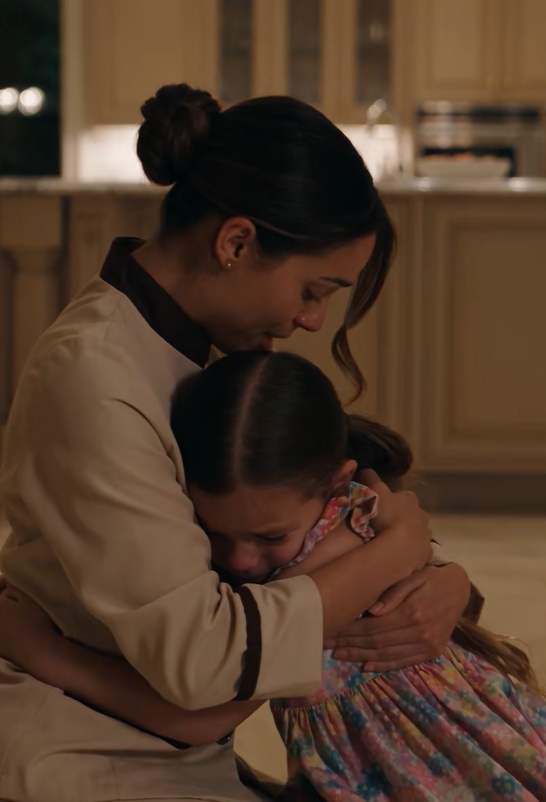
The woman let out a sound that was half sob, half prayer. In an instant, seven years of grief, searching, sleepless nights, broken leads, and impossible hope crashed through her all at once. She pulled the boy into her arms with desperate tenderness, as if afraid he would vanish again if she loosened her grip. The little girl, startled but understanding that something sacred was happening, threw her arms around both of them. The sandwich remained crushed in the boy’s hand, forgotten now, as he clung to the woman with the desperate confusion of someone holding a miracle he did not yet fully understand. “My babies,” she cried through tears. “My babies… I finally found you.” The little girl looked up at the boy with wide eyes, realizing that the lonely child she had noticed in the alley was not a stranger at all, but part of her own family — the brother taken so many years ago, the mystery her mother had never stopped grieving. And as the three of them held each other against the glowing brick wall, wrapped in the last golden light of evening, the truth settled over that quiet alley with overwhelming force: what had begun as a simple act of kindness had just uncovered a lost child, a shattered family, and a love that had somehow survived seven long years of silence.