The slap came before the man even had time to turn completely toward the person speaking behind him.
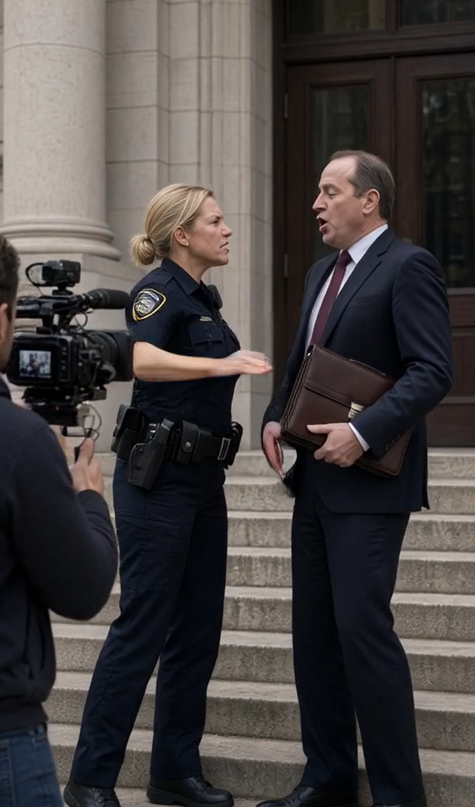
His head jerked to one side from the force of the blow. The leather briefcase hanging at his side swung briefly before coming to rest. Yet he remained on his feet. He made no attempt to defend himself or strike back. For a moment, he stood motionless on the courthouse steps, his cheek stinging as the noise around him seemed to disappear.
Standing directly in front of him was a blonde female police officer. Her uniform was immaculate, and the badge on her chest reflected the daylight. Beneath the brim of her cap, her jaw was set firmly. She regarded him with the same expression someone might wear after making an ordinary point in an argument they believed they had already won.
“I told you to move when I give you an instruction!”
The man slowly turned his face toward her again. He was white, dressed in an expensive suit, and considerably older than the officer. The age difference alone should have encouraged a more measured response, but nothing about her attitude suggested she had considered it. His briefcase remained firmly in one hand, while the other hung loosely beside him.
“You just did that in front of a live television camera,” he replied.
Only a few feet away, a cameraman stood behind a professional broadcasting camera pointed directly at them. Its red recording indicator was illuminated. The man had noticed the camera even before the officer struck him. He also noticed the moment her eyes shifted toward the lens.
For a brief instant, she appeared to realize what that camera might mean. Then she laughed dismissively.
“Keep your mouth shut. Save your lawyer routine for somebody who gives a damn.”
She extended one finger toward his chest, speaking loudly enough for everyone nearby to hear. The cameraman continued recording without lowering his equipment.
The man chose not to respond to her insult. For decades, he had presided over complicated federal cases in courtrooms where emotions could become overwhelming without changing a single fact. He had witnessed people confuse loud voices with authority, self-confidence with evidence, and public humiliation with a way of forcing others into submission. He understood the temptation to respond aggressively when someone used force against him. But he also understood how such a reaction could affect the official account of what had happened.
So he remained still.
A second police officer hurried down the courthouse steps. Almost immediately afterward, several courthouse security employees came through the enormous wooden entrance doors. The second officer’s expression changed dramatically when he recognized the man.
“Chief Judge! Sir, are you all right? Have you been injured?”
The blonde officer’s confident smile disappeared.
“Chief… Judge?” she repeated, almost unable to believe what she had just heard.
The man straightened his jacket. He paid no attention to the camera. Instead, he looked directly at the woman who had slapped him, then turned toward the second officer, who had stopped several feet away, apparently uncertain whether he should come closer.
“Officer, I believe the entire country may have just seen what happened here.”
He was not claiming to know exactly how many people had witnessed the incident. From where he stood, he could see the red recording light and hear the faint mechanical sound of the equipment. He had no way of knowing where the footage was being transmitted, how large the audience might be, or whether the broadcast would continue. He was simply making one point clear: this had not happened behind closed doors, and there had been a camera present throughout the encounter.
The blonde officer’s face lost its color. Once again, she looked toward the camera. The red light was still glowing.
The courthouse security team reached them. A female employee carrying a radio looked at the judge’s cheek, then at the officer, and finally at the cameraman. Her eyes moved quickly from one to the next, suggesting that she had already received some information but had not yet understood the full situation.
“Chief Judge, we can escort you inside,” she offered.
“I’m fine,” he answered. “But first, I’d like to understand why I was stopped.”
The female officer began to speak, but the second officer interrupted before she could explain.
“Sir, I heard the radio call and came straight outside. I wasn’t here when the initial encounter began.”
“Thank you,” the judge replied. “In that case, please don’t claim to have witnessed something you didn’t see.”
The officer nodded. The distinction appeared to reassure him. He shifted slightly to one side, no longer attempting to position himself between the judge and the woman who had struck him.
The security employee holding the radio glanced toward the entrance. Another member of the team approached, carrying a small tablet. He leaned toward her and spoke quietly, but the surrounding silence allowed the judge to hear him.
“We located the earlier footage. It’s from the entrance camera.”
The woman’s expression became more serious.
“What earlier footage?” the judge asked.
She turned toward him. “There is a recording from the exterior entrance. It covers the approach area and the security desk. We’re checking the relevant time period now.”
“How far back does it go?”
“About ten minutes, if necessary.”
The judge looked directly at her.
“Then I’d like to review what happened during those ten minutes.”
Everyone on the steps fell silent.
He had not raised his voice or issued an aggressive command. It was simply a reasonable request concerning the events that had led to an incident now being recorded in public. The security employee understood that the footage might reveal something far more important than the title the second officer had just announced.
For several moments, nobody moved. The cameraman continued filming, and the red recording indicator remained illuminated.
The judge shifted the briefcase slightly in his hand. His cheek continued to burn, but he kept his attention on the security employee.
“Can you make sure the original recording is protected before anyone watches it?”
“Yes. We can secure the original file and document the exact time period.”
“Please do that. I don’t want someone showing me an edited version, and I don’t want people relying on their memories when the actual recording is available.”
The employee nodded and quietly relayed the instruction over her radio. Another security worker headed toward the courthouse doors, while the second officer remained where he was.
The blonde officer looked around at the people gathered nearby.
“I was responding to a security matter,” she insisted.
The judge waited a moment before answering.
“What security matter?”
“We received a report. I was instructed to clear the entrance.”
“Who gave you that instruction?”
She hesitated before responding.
“Security.”
The woman holding the radio looked at her. Her expression was neither openly hostile nor supportive.
“We’ll establish exactly what happened,” the judge said. “For the moment, I want the recording preserved.”
The officer raised her shoulders defensively.
“He refused to move.”
The judge briefly glanced at the courthouse steps before returning his attention to her.
“You’ve explained that you instructed me to move. I heard you. But what happened after that instruction is another matter. Those are two separate issues.”
Her face reddened.
“I was simply doing my job.”
“Then the evidence should help establish what your duties required of you at that particular moment.”
He delivered the statement without sarcasm or anger. Somehow, that calm response seemed to make her even more uncomfortable. The second officer lowered his eyes toward the pavement, while the cameraman adjusted his position to keep everyone in the frame.
The security employee turned to the cameraman and asked whether the broadcast was still live.
He confirmed that it was and that he was also recording the entire encounter. She requested that he retain the original, unedited footage and avoid moving any closer. He agreed.
The judge made no request for the cameras to be switched off.
The blonde officer continued staring at the lens.
“You can’t just put me on television,” she protested.
The cameraman answered calmly.
“I’m not the one who chose to do this in front of a camera.”
The judge raised one hand, not to silence the cameraman, but to prevent the conversation from developing into another confrontation.
“There’s no reason to argue about the broadcast at this moment. What matters is establishing an accurate record of events.”
One of the courthouse security employees opened a large wooden door and held it for him. The judge did not immediately enter.
“Before I go inside, I want the officer’s name and the department she works for properly documented. I also want the identity of the security employee who supposedly gave her the instruction she mentioned.”
The woman with the radio took a breath.
“I can confirm the identities of our own personnel. I cannot provide information on behalf of the officer’s department.”
“That’s completely reasonable.”
The officer’s expression changed once again. Perhaps for the first time, she began to understand that the judge was not attempting to interfere with her department or use his position to take control of it. He simply wanted an accurate account of the incident, independent of the embarrassment she had experienced upon discovering his identity.
The second officer stepped closer.
“Sir, I can arrange for medical personnel to examine your cheek.”
“Thank you. I might accept that shortly.”
“It’s quite red.”
“I’m aware.”
His ordinary response briefly left the officer without anything to say.
The judge turned his attention back to the blonde woman.
“I’m not asking you to explain your actions in front of the television cameras. I am asking you to remain here until the relevant information has been properly documented.”
“I wasn’t planning on leaving,” she replied.
“Good.”
The security employee turned toward the entrance.
“Chief Judge, the director is inside. She can meet with us in the security office, where the exterior recording is stored.”
“Has anyone already watched it?”
“Not the entire ten-minute period. One of our employees noticed a sequence that could be connected to the original security alert. We stopped the review before going any further.”
“What exactly did they notice?”
The employee glanced briefly toward the female officer.
“I would prefer not to describe it until the original file has been secured.”
“That’s the right approach.”
Finally, the judge began walking toward the entrance. His briefcase remained in his hand. He did not push past the officer or demand that anyone remove her from the steps. The second officer followed several paces behind him. The security employee stayed near the blonde woman without touching her, while another member of the team continued communicating over the radio.
Before crossing the threshold, the judge stopped and looked back at the cameraman.
“Please make sure you retain the original footage, not merely the version used for the broadcast.”
“We’ll preserve it,” the cameraman assured him.
The judge then entered the courthouse.
Inside, the air felt noticeably cooler than it had outside. The entrance hall carried a faint smell of stone, paper, and freshly polished floors. The security employee guided him away from the public corridor and toward a small administrative office. The second officer followed until the judge turned around at the doorway.
“You may remain here if the security director needs your account. Just make sure you distinguish what you personally witnessed from what someone else told you.”
“I understand, sir.”
The judge placed his briefcase on a nearby chair. Only then did he carefully touch his cheek. The skin felt hot beneath his fingertips. There was no bleeding, and the redness would probably disappear with time. Still, he suspected the memory of the incident would last considerably longer than the physical discomfort.
A member of the medical staff soon arrived and asked whether he would agree to a brief examination. He accepted. The staff member checked for dizziness, changes in vision, pain around the jaw, and any indication that he had fallen. He answered every question.
The examination revealed no obvious injury beyond tenderness and redness. The medical employee advised him to seek additional care if his symptoms changed. He thanked her and requested that her report include only the findings she had personally observed, rather than information supplied by other people.
Shortly afterward, the security director entered carrying a folder under one arm. She appeared composed, although the tension between her eyebrows suggested that the incident had already become more complicated than she had anticipated.
“Chief Judge, I want to apologize for what happened outside.”
“Thank you. Before we discuss anything else, I’d like to know why that officer stopped me.”
She opened the folder.
“The officer had been assigned to the exterior entrance while our team investigated a report concerning an unattended case near the public vestibule.”
The judge glanced toward his briefcase, which was resting on the chair.
“An unattended case?”
“Yes. It was a small delivery case. Someone reported that it had been left unattended earlier this morning.”
“Was there any indication that it posed a threat?”
“No. It was identified and cleared.”
“When was that done?”
The director paused before answering.
“Before the encounter on the steps.”
The judge remained completely still.
“How much earlier?”
“Approximately ten minutes.”
He looked at the folder in her hands.
“Now you understand why I requested the earlier recording.”
The director nodded.
“The exterior camera covers both the public entrance area and the security desk. It may show the officer receiving the update.”
“May show it?”
“The camera doesn’t capture every conversation clearly. One of our employees says he informed her that the area had been cleared. The recording might show their interaction, although it may not capture the actual words.”
“Then we need to keep separate what the footage establishes and what the employee remembers.”
“Agreed.”
“Who currently has access to the original file?”
“Our security systems custodian. The footage is being preserved. I’ve instructed the team not to overwrite it or create an exported copy until the original has been secured and the access history documented.”
“Good. The television footage needs to receive the same treatment.”
The director glanced toward the doorway.
“The officer maintains that she was told to clear the entrance because of the security report.”
“She may have received that instruction. But you have just confirmed that the reported item had already been cleared before she approached me.”
“Yes, that’s correct.”
“And you’ve also told me that an employee remembers informing her of that fact.”
“Yes.”
“Then the important question isn’t simply whether a security report existed. We need to establish what she actually knew when she approached me.”
The director remained silent. This silence was different from the one outside. It was the silence of someone beginning to understand that a seemingly minor administrative detail could completely change how an entire incident was interpreted.
The judge opened his briefcase, removed a folded schedule, and then placed it back without even looking at it. He had been on his way to an ordinary meeting. That meeting could be postponed. What had happened on the public courthouse steps, however, could not be treated as though it had occurred in a private room. The camera had already made the incident impossible to quietly contain.
“Please secure the footage,” he repeated. “Keep a record of everyone who accesses it. And don’t allow anyone to tell me what they think it proves before we know exactly what it contains.”
The director nodded.
Outside, the blonde officer was still standing on the courthouse steps. The cameraman remained nearby, and the second officer was positioned close to the entrance, occasionally looking toward the woman he had left behind.
Nobody had ordered the officer to leave. Nobody had officially declared her guilty. And nobody had assured her that there would be no consequences.
The earlier recording had still not been played.
Nevertheless, the explanation for the incident had already begun to change. The officer had claimed that she was clearing the entrance because of a security alert. The director confirmed that such a report had indeed existed. But she also confirmed that the matter had been resolved before the slap took place.
The judge turned toward the director.
“Let’s find out what the recording actually shows.”
During his many years on the bench, he had learned that even a simple request for evidence could feel threatening to someone who had never expected to be questioned. The announcement of his title on the courthouse steps had changed the atmosphere completely. He could see it in the security employee’s careful choice of words, in the second officer’s deliberate posture, and in the way the woman outside had suddenly stopped behaving as though nobody had the right to challenge her actions.
But he did not want his official position to become the central issue.
If he had been an ordinary attorney, the slap would still have been significant. If he had been a delivery driver, a visitor, or simply someone asking for directions, the camera would still have captured a police officer striking a person who had made no attempt to hit back.
His position explained why the second officer had recognized him. It did not create the injury, nor did it make him more entitled to have the incident taken seriously.
The security director seemed to understand the distinction he was trying to maintain.
“Would you like me to arrange for the officer to provide a statement now?” she asked.
“No. Not while everyone is reacting to the discovery of my identity. Let the appropriate authorities obtain her account through the normal procedure. I want the original footage secured, the camera operator identified, and the entire sequence preserved. I don’t want an informal conversation that could create another disagreement about what was said.”
“Understood.”
“One more thing. I don’t want anyone telling the officer that I requested a particular punishment or outcome.”
“I wouldn’t do that.”
“Please make sure everyone understands. I have not requested disciplinary action. I have requested that the evidence be preserved.”
The director wrote something in her folder.
“There will probably be questions about whether you should participate in the review at all.”
“There should be. I am the person who was struck, so I can describe what happened to me. But I should not decide what action her department takes, and I should not determine whether a member of your security team followed the correct procedure.”
The director studied him for a moment.
“That may be the most important thing you’ve said since coming inside.”
“It is also the most obvious.”
“Unfortunately, people don’t always find the obvious easy to follow when emotions are involved.”
He almost smiled, but the movement caused discomfort in his cheek.
“I am angry. I’m simply trying to make sure my anger doesn’t interfere with an accurate record.”
The second officer, who was still standing near the doorway, had heard the exchange. He looked as though he wanted to say something but wasn’t certain whether he should.
“You can speak,” the judge told him. “Just make sure your account is precise.”
The officer took a breath.
“I recognized you immediately, sir. I’ve seen you around the courthouse. But I have no idea what happened before I arrived. I heard raised voices, and someone on the radio mentioned a problem on the steps.”
“Did you hear the woman give me an instruction?”
“No. I only heard her after the slap. I also heard you mention that the camera was live.”
“Did you actually witness the physical contact?”
“No, sir. When I arrived, I saw you standing there afterward. I didn’t see her hand strike you.”
“Then that’s exactly what your statement should say.”
The second officer nodded. It was a small exchange, but the judge noticed the relief in his expression. The officer had arrived wanting to help while also worrying that he might say something inaccurate. Being told that an incomplete but honest account was still valuable seemed to give him some reassurance.
Suddenly, the director’s radio crackled. She listened carefully, asked a brief question, and then turned back toward the judge.
“The original exterior recording has now been placed on hold. The systems custodian is documenting its access history. The security supervisor who spoke with the officer is also available.”
“Is he the person who told her the area had been cleared?”
“Yes.”
“Then his statement should be collected independently from everyone else’s. We mustn’t allow the first explanation to become the accepted version simply because it’s the easiest one to repeat.”
“I’ll arrange that.”
The judge picked up his briefcase. The small office had no windows, and the fluorescent lighting made the redness on his cheek appear even darker than it had outside. He placed the case down again.
For the first time since being struck, he allowed himself to think about how easily the situation might have developed differently.
If he had raised his hand in response, the camera would have recorded that as well. If he had shouted at the officer, she might have portrayed him as aggressive or threatening. And if he had simply walked away without requesting the earlier recording, the reason for the stop might have been repeated so many times that people eventually accepted it as an established fact.
But he had done none of those things.
He had asked for the original recording.
The director opened the office door.
“We can take you to the review room as soon as the systems custodian is ready.”
“Not until the original file is properly secured.”
“It has been secured.”