The first light of dawn stretched across the massive international airport, bathing the endless runway in soft shades of orange. Crews were already scattered across the tarmac, preparing aircraft for the day’s early departures. Cargo trucks crawled across the concrete while the distant thunder of jet engines rolled through the crisp morning air.
Near the far edge of the maintenance zone, a restricted area had been sealed off with bright yellow safety tape. Pieces of a dismantled aircraft engine were spread across metal tables and tool carts — cracked turbine casings, tangled wiring, and heavy blades that had been removed from a cargo plane after a serious malfunction the night before.
Airport engineers had already inspected the wreckage and reached a firm conclusion.
The damage was beyond repair.
Replacing the parts would cost hundreds of thousands of dollars, and the grounded aircraft was expected to remain stuck at the airport for weeks.
But something unexpected was unfolding beside the pile of broken machinery.
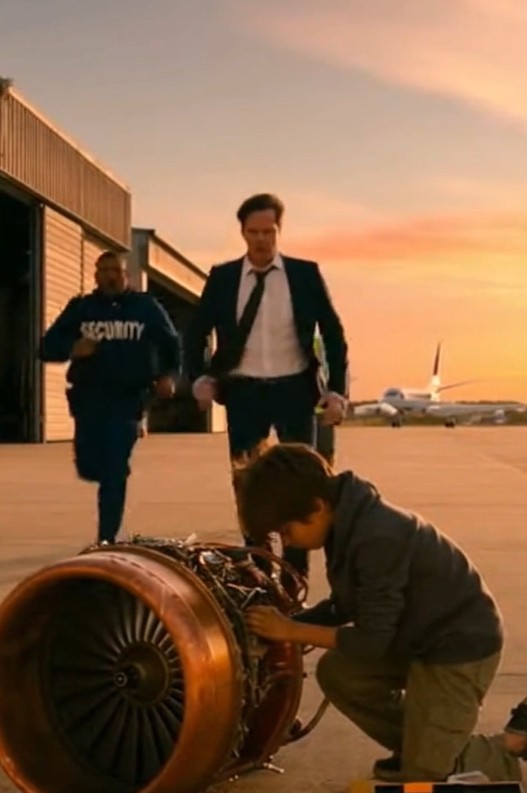
Kneeling on the cold concrete floor was a boy who couldn’t have been older than twelve.
His clothes were worn and torn. Oil stains darkened the sleeves of his shirt, and his jeans were ripped at the knees. Grease covered his hands and smudged across his cheeks. Beside him rested an old, battered toolbox that looked like it had survived years of hard use.
The boy leaned over a turbine casing, tightening a bolt with a small wrench.
His hands moved slowly, deliberately.
There was no hesitation in his actions.
He turned the turbine with his fingers, listening closely to the sound of the metal spinning. Then he adjusted an inner component and wiped sweat from his forehead with his sleeve.
Not far away, several airport mechanics had already walked off earlier after confirming the damaged parts were useless.
At first, nobody noticed the boy.
But suddenly one engineer glanced back toward the maintenance area — and froze.
“What the…?” he murmured.
He squinted and pointed.
“Is that… a kid?”
Two other workers turned around.
Sure enough, sitting in the middle of equipment worth millions of dollars was a small boy calmly repairing a turbine that had already been written off.
“Hey!” one mechanic yelled.
The boy didn’t even look up.
He continued tightening the bolt.
The workers marched toward him, irritation growing with every step.
At that same moment, a sleek black airport SUV pulled up nearby. A sharply dressed man stepped out, his polished shoes clicking against the pavement. Wearing a tailored suit and dark sunglasses, he carried the air of someone used to being in charge.
His name was Daniel Carter — the operations director responsible for the disabled cargo aircraft.
Daniel had already spent the entire morning locked in tense discussions with engineers and executives about the costly repair disaster.
The last thing he expected to see was a random kid touching critical aircraft components.
“What’s going on over there?” Daniel asked sharply.
One mechanic pointed.
“Sir… there’s a kid messing with the turbine parts.”
Daniel’s expression hardened instantly.
“What?”
Without hesitation, he and two mechanics rushed toward the boy.
Meanwhile, the kid calmly finished reconnecting several wires inside the engine casing. He secured the cover and tightened the last screw.
Just as he finished, the three men reached him.
“What the hell are you doing?!” Daniel shouted.
The boy slowly looked up.
His face was calm, though streaked with grease.
Daniel gestured angrily at the scattered parts.
“These components are completely destroyed,” he said. “Our engineers already checked them. They can’t be fixed.”
One mechanic added firmly, “Kid, you’re not even supposed to be here. This area is restricted.”
The boy said nothing at first.
He wiped his hands with a rag, then stood up.
Even standing, he barely reached Daniel’s shoulder.
Yet his voice remained steady.
“Check them again,” he said quietly.
Daniel frowned.
“What?”
The boy pointed toward the turbine.
“I fixed everything.”
The mechanics exchanged puzzled glances.
Daniel scoffed.
“This isn’t a toy,” he replied. “These are aircraft engines. Even our senior engineers couldn’t repair them.”
The boy didn’t argue.
Instead, he stepped aside and gestured toward the turbine housing.
“Try it.”
One of the mechanics knelt beside the part and grabbed the shaft, slowly rotating it.
His face changed instantly.
The harsh grinding sound that had been there earlier was gone.
The turbine spun smoothly.
He turned it faster.
Still smooth.
“What…?” he whispered.
Another mechanic crouched down and inspected the wiring.
“These cables were completely burned last night,” he said.
Now they were neatly reconnected, cleaned, and secured.
Even the damaged support bracket had been reinforced.
Daniel pushed forward and opened the motor casing.
His eyes widened.
Inside, the internal components had been reorganized and repaired with incredible precision.
Whoever did this understood aircraft engines inside and out.
Daniel slowly stood and stared at the boy.
“That’s impossible,” he said quietly.
He pointed at the repaired turbine.
“Who helped you?”
The boy shook his head.
“No one.”
Daniel studied him carefully.
“Who are you?”
The boy hesitated before answering.
“My name is Leo.”
Daniel crossed his arms.
“How does a kid your age know how to repair turbine engines?”
Leo glanced down at his toolbox.
“My father used to fix them,” he said softly.
Daniel’s expression shifted.
“Used to?”
Leo nodded.
“He worked at this airport.”
One mechanic suddenly looked stunned.
“What was his name?”
“Michael Rivera.”
The workers exchanged looks.
One gasped.
“Rivera?”
Daniel turned.
“You knew him?”
The mechanic nodded.
“Everyone did. He was one of the best engineers we ever had here.”
Daniel’s eyes widened.
“But he passed away years ago,” the man added quietly.
Leo looked down.
“He died four years ago.”
Silence settled over the maintenance area.
Daniel glanced at the repaired turbine… then back at the boy.
“Your father taught you this?”
Leo nodded.
“He used to take me to the workshop after school,” he said. “I watched him fix engines every day.”
Daniel studied him carefully.
The calm focus.
The precision.
The confidence.
This boy wasn’t guessing.
He had grown up learning the craft.
Daniel let out a quiet, amazed laugh.
“You just repaired something our engineers couldn’t,” he said.
Leo shrugged slightly.
“They weren’t broken,” he explained. “They were just put back together wrong after the emergency removal.”
The mechanics exchanged stunned looks.
One grabbed a radio immediately.
“Testing crew to runway maintenance zone,” he said. “We need diagnostics on turbine assembly A.”
Within minutes, engineers arrived carrying diagnostic equipment.
Sensors were attached. The system powered up.
Everyone held their breath.
The turbine slowly began spinning.
Smooth.
Balanced.
Perfect.
One engineer looked up at Daniel, wide-eyed.
“It’s working.”
The entire maintenance crew turned toward Leo.
The small boy stood quietly beside his toolbox.
Daniel walked over again.
This time his voice carried respect.
“You just saved this airport hundreds of thousands of dollars,” he said.
Leo simply picked up his toolbox.
“I should go.”
Daniel stopped him.
“Wait.”
Leo turned back.
Daniel glanced at the crew — then back at the boy.
“How would you like to work here someday?”
Leo blinked.
“What?”
Daniel smiled.
“You may only be twelve,” he said, “but you’ve got the mind of an engineer.”
He gently placed a hand on the boy’s shoulder.
“And I think your father would be incredibly proud.”
For the first time, Leo smiled.
And as the repaired turbine roared back to life behind them, everyone in the maintenance yard realized they had just witnessed something extraordinary.
The legacy of a brilliant engineer…
still alive in the gifted hands of his son.