Captain Elena Hart had learned an unusual skill: how to smile without moving her jaw.
Four years earlier, an improvised explosive device tore through her convoy near Kandahar. Metal screamed, dust swallowed the road, and three of her teammates were killed instantly. Elena survived—but survival came at a heavy price. Doctors counted thirty-two pieces of shrapnel still lodged inside her body. They were too close to her liver, spine, and carotid artery to remove safely.
The surgeons told her she was lucky.
Elena stopped believing in the word “lucky” the day the headaches began.
They struck suddenly—like lightning behind her eyes. The pain was blinding, forcing her to cling to the sink in the bathroom while nausea twisted her stomach. Then came the dizziness. After that, the deep stabbing ache in her ribs where one fragment sat near her diaphragm, turning every full breath into a challenge.
Yet every morning she braided her hair tightly, put on her perfectly pressed uniform, and walked into headquarters at Fort Rainer as if pain were nothing more than a rumor.
Because in the Army, invisible injuries often look like excuses.
And her battalion commander, Colonel Victor Reddick, made sure everyone knew what he thought.
“She’s always at medical,” he once said in front of the platoon. “But I don’t see a limp. I don’t see a cast. What I see… are excuses.”
Each time he said it, the room fell silent. Soldiers stared straight ahead, pretending they weren’t witnessing a warning about their own futures.
A Hearing That Could Destroy Her Career
Desperate to prove she was still valuable, Elena pushed herself harder than ever: extra physical training even on bad days, volunteering for additional duties, submitting flawless reports. But the harder she pushed, the worse her symptoms became.
When she finally requested a medical profile adjustment, Reddick treated it like a complaint.
In his report he wrote that she was “manipulating the system.”
Then he recommended disciplinary action.
The notice arrived on a Friday.
A formal hearing with brigade leadership.
Elena sat at her kitchen table staring at the paper until the words began to blur. What frightened her most wasn’t punishment.
It was the label.
Malingerer.
In the military, that word can destroy a reputation faster than any mistake.
On Monday, the conference room was packed.
The brigade sergeant major.
A legal officer.
Colonel Reddick.
Elena stood alone at the end of the long table, steady only because she had learned to lock her joints when vertigo struck.
Reddick spoke first.
He called her unreliable.
He called her weak.
He called her a danger to readiness.
And then Elena did something that shocked everyone—even herself.
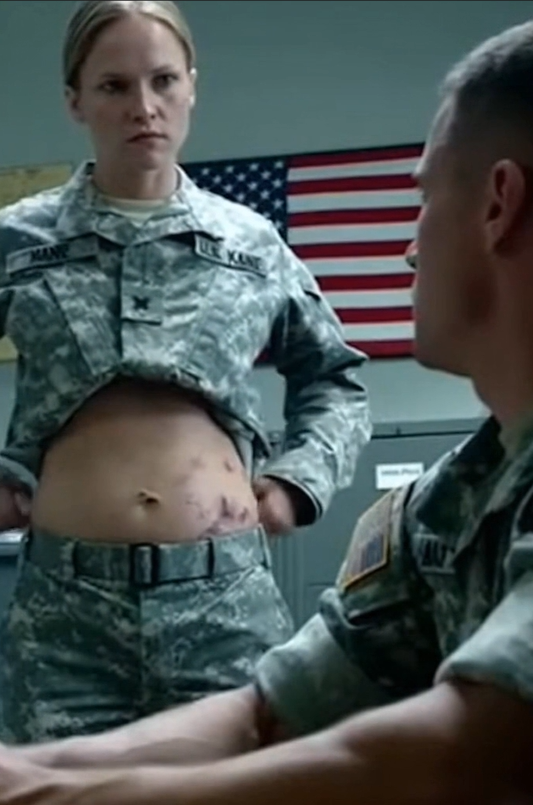
Slowly, she reached for the buttons of her uniform blouse.
Gasps spread through the room as the fabric opened.
Underneath appeared a map of scars—puckered shrapnel wounds and raised tissue tracing the explosion that nearly killed her.
Colonel Reddick went pale.
But the moment wasn’t over.
Because just then the door behind them quietly opened.
A woman stepped into the room holding a thick medical folder.
The Doctor Who Knew the Truth
“Dr. Nora Caldwell,” she said calmly. “Kandahar Field Hospital, 2022.”
Elena felt her throat tighten.
She remembered the evacuation flight and the doctor leaning close, whispering:
Stay awake. If you fall asleep now, you may not come back.
Dr. Caldwell placed the folder on the table.
“Captain Hart’s injuries were documented in theater,” she said. “CT scans confirmed thirty-two retained fragments. Surgical removal was ruled out because of their proximity to vital organs. Her survival probability upon arrival was estimated at fifteen percent.”
The brigade sergeant major glanced from the papers to Elena’s scars.
The legal officer swallowed.
Reddick tried to regain control.
“With respect, doctor, she runs physical training. She performs her duties. These complaints don’t match her performance.”
Dr. Caldwell looked directly at him.
“That’s exactly the issue,” she replied.
“People with chronic trauma often overperform because they’re terrified someone like you will call them weak.”
The room fell silent.
For the first time in years, Elena stopped pretending.
The Question That Changed Everything
After the testimony, the sergeant major asked a simple question.
“Colonel Reddick, did you review these medical records?”
Silence answered.
The brigade commander spoke for the first time.
“You initiated disciplinary action without reviewing the full medical documentation?”
Reddick tightened his jaw.
“I acted in the interest of readiness.”
The commander responded calmly but firmly.
“Readiness also means keeping our soldiers alive.”
In that moment, Elena felt the atmosphere in the room shift.
The assumptions were beginning to crack.
A Confession She Never Expected
A week later, the case against her was withdrawn.
But something even more unexpected followed.
Colonel Reddick asked for a private meeting.
When Elena entered his office, she noticed the photograph on his desk: a young soldier smiling proudly. A black ribbon wrapped around the frame.
“My son,” Reddick said quietly. “Staff Sergeant Evan Reddick.”
Slowly, he told his story.
His son had come home from deployment changed—nightmares, panic attacks, bursts of anger. He refused to seek help because he feared it would destroy his career.
Last year, he died by suicide.
“When I saw your scars,” Reddick said hoarsely, “I realized I had been fighting the wrong enemy.”
For the first time, the commander who once tried to ruin her career looked like nothing more than a grieving father.
How a Movement Began
A few days later Elena received an email.
Subject line: Confidential
Inside was a proposal for a program called:
Silent Wounds
A support system offering confidential mental-health counseling, medical advocacy, and stigma-reduction resources for soldiers.
The listed authors surprised her:
Captain Elena Hart
Colonel Victor Reddick
Major Lena Park, Behavioral Health Officer
But the message ended with a warning:
Brigade headquarters does not support this initiative. Proceed discreetly.
Elena understood exactly what that meant.
Do it anyway—and be ready for consequences.
The Room Where Soldiers Finally Spoke
The first Silent Wounds meeting took place after duty hours in a small classroom.
No sign-in sheets.
No official records.
Just a circle of folding chairs and one rule written on the board:
What’s said here stays here.
At first no one spoke.
So Elena began.
She told them about the thirty-two fragments in her body.
About the fifteen-percent chance she had to survive.
About vomiting in the bathroom at work and returning to meetings with a practiced smile.
Then a young specialist spoke quietly.
“I thought I was just weak.”
And suddenly the room changed.
When the Truth Could No Longer Be Ignored
Within months the program spread across the base.
But opposition soon arrived.
A visiting general called the initiative “a distraction” and demanded the names of those attending.
Major Lena Park refused.
“If you want those names,” she said, “you’ll end up with fewer living soldiers.”
Even Reddick stood beside her.
Then tragedy struck.
A young private named Tyler Briggs died by suicide.
His note read:
I didn’t want to be the guy who couldn’t handle it.
After that, Elena and her team demanded a formal briefing with senior leadership.
This time they didn’t hide.
Elena presented the data.
Park explained the stigma.
Dr. Caldwell described the medical realities.
Reddick spoke last.
“My son died because he believed asking for help meant weakness,” he said quietly.
“If we continue treating invisible wounds as excuses, we are choosing funerals.”
The room fell silent.
Then a general asked the question Elena had waited years to hear.
“What do you need to make this official?”
When Scars Became Strength
Weeks later Elena stood inside the Pentagon delivering a briefing.
She ended with one sentence that carried the weight of everything she had survived:
“Invisible wounds don’t make soldiers weaker. They prove what we survived.”
The program was approved.
Funding followed.
Training programs began.
Confidential support systems became official military policy.
Two years later, Elena pinned on the rank of Major.
Her headaches still returned sometimes.
But she was no longer fighting alone.
One evening at the memorial wall, she traced her fingers across the names of the three teammates she had lost in Kandahar.
Colonel Reddick stood quietly beside her.
“You were right,” he said softly.
Elena looked at the rows of flags.
“I wasn’t trying to shame anyone,” she replied.
“I just wanted to make sure the next soldier wouldn’t have to undress their dignity just to be believed.”
The fragments inside her body would never disappear.
But they were no longer just wounds.
They had become keys—opening doors for others who had been suffering in silence.