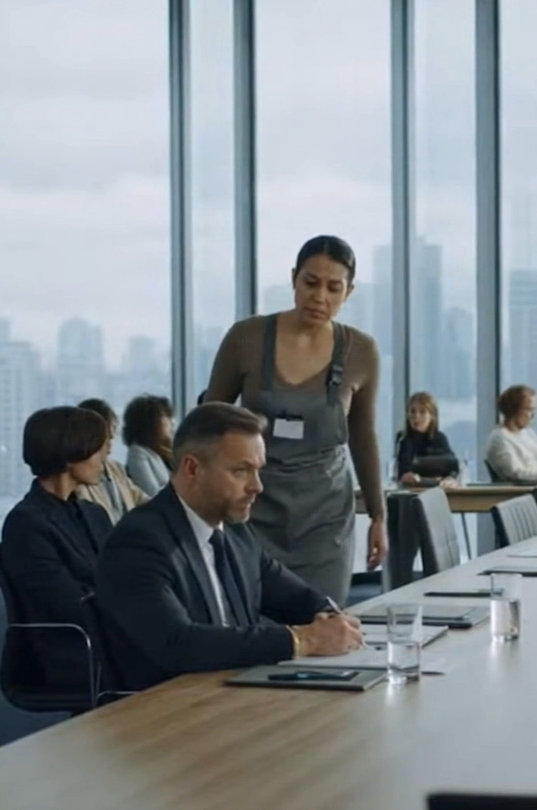
The pen froze just a fraction above the paper.
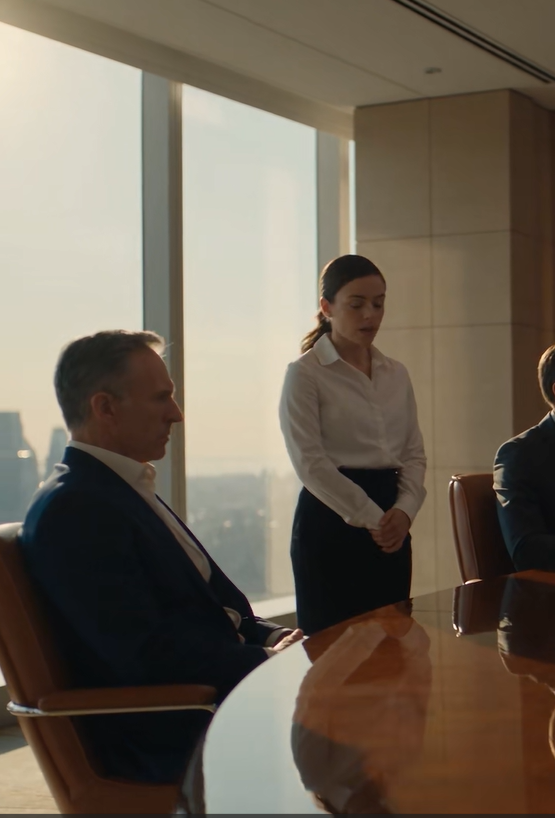
Across the perfectly polished table, the billionaire’s hand trembled so violently that the ink at the tip of the pen seemed to vibrate. It felt as though his body already understood — this was the moment everything would finally collapse.
His suit was impeccable.
But his face was not.
Sweat gathered at his temple. His throat tightened as if he were trying to swallow something heavy and sharp. Around him sat the lawyers — motionless, tense, silently staring at the documents as if they were a coffin about to be sealed.
And then, almost inaudibly, a voice cut through the silence:
“Sir… please don’t sign that.”
A waitress stood by the doorway, a tray still in her hands. Her uniform was slightly worn, her fingers damp from dishwater. But her gaze — focused, piercing — was fixed on the papers as if she had seen something everyone else had missed.
The lead attorney snapped sharply:
“This is a private meeting. Leave.”
But the billionaire didn’t move.
He looked at her — with irritation and, at the same time, a flicker of desperate hope. Because for the first time in a long while, someone in that room sounded certain.
The girl stepped forward. Her voice trembled slightly, but did not break:
“There’s a mistake… a big one.”
Daniel Addison leaned back in his chair and closed his eyes for a moment.
The past few months echoed in his mind:
Your credit line has been frozen.
We are withdrawing from the partnership.
Interest rates have changed.
Each sentence hit like a blow to the chest.
Three lawyers sat across from him — cold, composed, professional. Yet even behind their calm, tension seeped through. Bankruptcy is never a victory. Even when it’s called “strategic.” It’s still a burial, just dressed in polite language.
“Once you sign, we’ll file immediately,” the lead attorney said. “This protects you.”
Protects you?
Daniel almost laughed.
What kind of protection is there in surrender?
He looked down at the papers again. Page after page reduced his life to numbers: assets to be seized, shares to be liquidated, properties to be “restructured” — a softer word for taken.
His eyes burned.
He thought of his father — a dock worker who came home smelling of salt and oil. A man who believed his son would never bow.
He thought of his mother, selling fruit under the blazing sun so he could afford textbooks.
If they could see me now…
The silence pressed in.
And then, in his mind, her voice echoed again:
“There’s a mistake.”
Daniel opened his eyes and looked once more at the line she had pointed out.
At first glance, it seemed ordinary — standard wording, nothing unusual. He had seen clauses like this countless times.
But something in the way she said it wouldn’t let go.
He leaned forward.
“Pause.”
The lawyers looked up.
“I want that clause reviewed again. The one about the debt from the Eastern Harbor acquisition.”
“We’ve already reviewed it. It’s airtight.”
“Review it again.”
After a brief pause, the attorney nodded and asked for the original documents.
A few minutes later, one of them frowned.
“This is… strange.”
Daniel’s heart pounded.
“What is it?”
“It says here the entire debt was transferred to your company…
But according to the acquisition agreement, only sixty percent was meant to transfer. The remaining forty percent stays with the original owner for five years.”
Silence.
“Five years…” Daniel repeated. “And how long has it been?”
“Four years and eight months.”
Something shifted in the room.
“That means… this debt shouldn’t be counted yet?”
“Yes… your total liability has been overstated.”
The word overstated echoed like a lock clicking open in the dark.
First came anger. Then confusion.
And then something far more dangerous —
Hope.