Marco DeLuca was the kind of man whose signature could move markets and whose presence filled entire skyscrapers. Wealth followed him effortlessly—private jets, oceanfront villas in Monaco, penthouses in Manhattan, and a car collection that gleamed like a luxury showroom. He had built an empire that most people could only dream of. Yet when the meetings ended and the mansion grew quiet, the silence felt heavier than gold, because the one thing he truly longed for—his mother’s memory—was slipping through his fingers.
His estate was less a home and more a monument: marble floors polished to perfection, ceilings that stretched toward the sky, windows overlooking a city that never slept. But inside those grand walls lived Elena, his once-vibrant mother, now trapped in the merciless fog of Alzheimer’s. Day by day, the illness erased her memories piece by piece. Nurses rotated in careful shifts, renowned doctors prescribed treatments, specialists guided her gently through manicured gardens—yet none of them could reach her. To Elena, everyone had become a shadow. Even Marco. And when she once looked at him and quietly asked, “Who are you, young man?” it shattered him in a way no financial loss ever could.
One exhausting afternoon, after closing another multimillion-dollar deal, Marco returned home drained. But something felt different. The air seemed lighter. Warmer. Then he heard it—music. A soft waltz drifted from the living room, the very place where his mother usually sat motionless, staring through the window. It was a melody from his childhood, once played in their modest kitchen long before wealth entered their lives. Curious and unsettled, Marco approached the door and opened it just enough to see inside—and what he saw stole his breath.
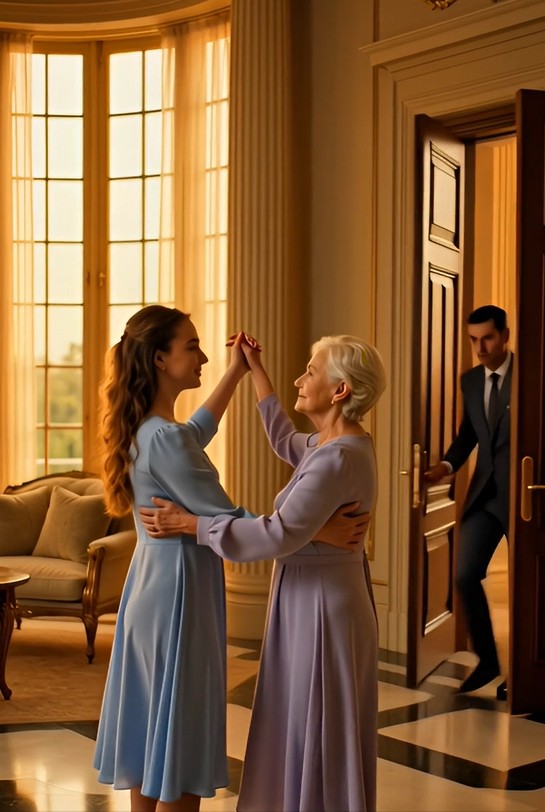
In the center of the grand room, Sofia Marino, a young caregiver hired only a week earlier, was gently dancing with Elena. Not guiding her. Not forcing her. Simply dancing. Elena, who barely moved these days, stepped carefully to the rhythm, her hands resting on Sofia’s shoulders. Her face glowed. She laughed—a soft, musical laugh Marco had not heard in years. Then, mid-dance, Elena looked at Sofia with sudden clarity and whispered, “Thank you, daughter.” The word echoed painfully in Marco’s chest. His own mother, who no longer recognized her only son, had just called a stranger daughter. He stood frozen, torn between heartbreak and a fragile spark of hope.
When Sofia noticed him, she apologized, but Marco stopped her and asked only one question: “How?” Her answer was simple—Elena might not remember names, but she remembered feelings. She needed familiar music, gentle touch, and to be treated not as a patient but as a woman who once lived and loved. That night, Marco sat beside his mother, played the same waltz, and held her hand without demanding recognition. Slowly, small miracles followed—smiles, soft humming, and one tender moment when she touched his cheek and whispered, “You seem kind.” It wasn’t “son,” but it was enough. And Marco finally understood that the greatest inheritance was not wealth or power—it was the love that remains, even when memory fades. 💫