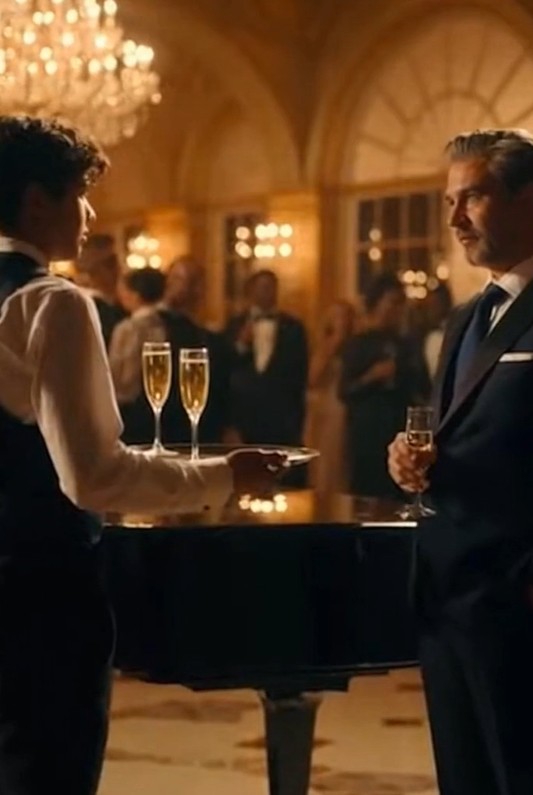
Crystal chandeliers shimmered above the marble floors of the grand ballroom, scattering golden light over silk gowns, polished shoes, and effortless laughter. Wealth did not need to introduce itself that evening; it lingered in every detail, from the quiet confidence of the guests to the glossy black grand piano waiting near the far wall. Beside it stood a thin fifteen-year-old waiter in a neatly pressed uniform, his shoes worn at the edges but clean. While he balanced a silver tray with steady hands, his eyes never left the piano, as if it were calling him by name.
To the crowd, he was invisible—another helper meant to move silently and disappear when not needed. But inside him, something stronger than the music was building. Gathering courage, he stepped toward a tall man in a navy suit whose watch alone was worth a fortune. “Can I… play this piano?” he asked quietly. The man smirked, loud enough for others to hear. “You? Have you ever even touched a piano?” A few guests chuckled, assuming the request was impossible. The boy’s cheeks burned, yet instead of retreating, he set the tray down and walked to the bench.
As he sat, a ripple of curiosity moved through the hall. His hands hovered over the keys, and when his sleeve shifted, a small guitar-shaped tattoo appeared on his wrist. The well-dressed man’s expression changed instantly. Years earlier, a video had circulated in private music circles—a young child playing a broken roadside keyboard with astonishing brilliance, a small guitar symbol drawn beside him. The child had vanished without a name. Now recognition tightened the man’s chest. “Wait… are you the one?” he whispered.
The boy answered not with words, but with music. The first note rang clear and pure, followed by another, then another, until the melody filled the hall and silenced every conversation. It was not merely skill; it was memory, longing, grief, and hope woven together. Guests turned slowly, glasses frozen midair, as the performance grew richer and more powerful. When the final note faded, the silence was complete before applause erupted across the room. “What’s your name?” the man asked softly. “Daniel,” the boy replied. He explained that his mother had taught him before illness took her strength, and that he once played in the subway because music could not pay for medicine.
Months later, that same melody echoed through a much larger hall. Daniel no longer stood unnoticed beside a tray; he sat center stage before an audience that had come only to hear him. The man who once mocked him listened from the crowd, humbled and grateful to have been wrong. Because sometimes the smallest question—“Can I play this piano?”—becomes the turning point of a life the world nearly overlooked, and the one no one sees is the one everyone was waiting for.