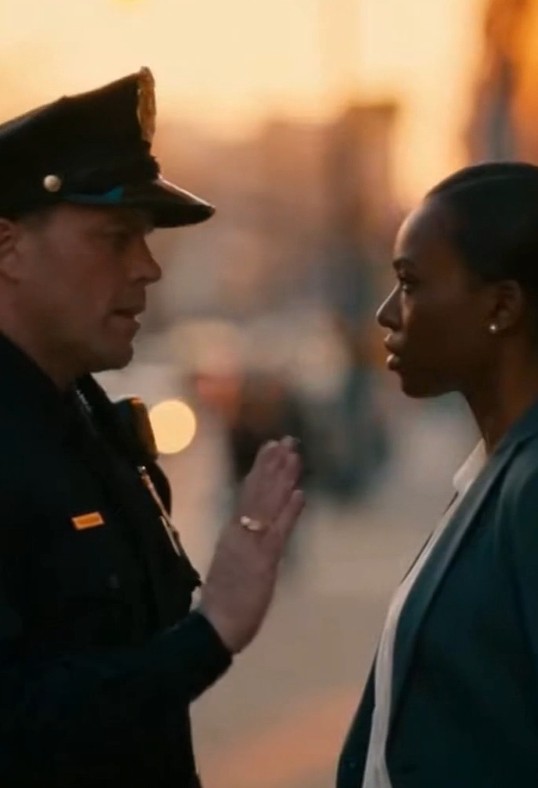
It was an ordinary evening on Jefferson Avenue. Cars moved steadily down the street, storefront lights flickered on, and the city slowly eased into its nighttime rhythm. She walked calmly and confidently — tailored blazer, leather bag at her side, heels tapping in an even cadence. She wasn’t rushing. She wasn’t looking over her shoulder. She looked like someone who knew exactly where she was going. And for some reason, that caught the officer’s attention.
He stepped forward and blocked her path. “You’re under arrest,” he said sharply, without explanation. She wasn’t running, arguing, or breaking any law. She simply stopped and asked, calmly, “For what?” His answer was cold and unsettling: “For being somewhere you don’t belong.” In that instant, the street seemed to freeze — pedestrians slowed down, someone lifted a phone, and tension thickened in the air.
When she slowly reached into her blazer pocket, his hand jerked toward his belt. But instead of panic, she pulled out a gold badge and held it under the streetlight. Real. Official. Just like his. His expression changed immediately — confidence draining from his face, replaced by sudden realization. He hadn’t asked questions. He had made an assumption — and he was wrong.
Later, the body-cam footage was reviewed behind closed doors. No raised voices, no excuses — just facts, and his words playing clearly in the room. It became obvious that this wasn’t about a law being broken. It was about a presumption. A belief that she “didn’t belong.” And that belief was the real issue.
Weeks later, she walked down the same street again. Same route. Same steady stride. Because the question had never been whether she had the right to be there. The real question was why anyone thought she needed permission to simply walk down her own street.