At first, everyone in the chapel thought the young woman in orange had lost her mind. The funeral had been quiet, heavy, and painfully formal—the kind of silence that settles over a room when grief has become too deep for words. Soft daylight poured through the tall chapel windows, falling across the polished white casket at the center of the room, where white roses and lilies had been arranged with heartbreaking care. Mourners dressed in black sat motionless in the pews, heads bowed, hands folded, eyes swollen from tears. The service had almost reached that unbearable moment when goodbye becomes final. Then, without warning, the chapel doors opened, and a young woman in a bright orange outfit stepped inside with a look on her face that made several people turn before she had even taken a second step. She did not move like a guest. She moved like someone racing against time.
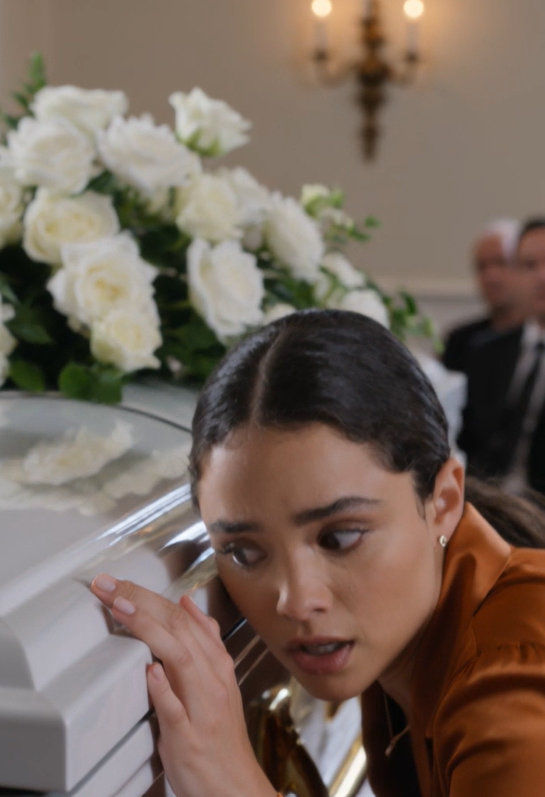
Ignoring the stunned faces around her, she walked straight down the aisle, faster and faster, until her steps became almost a run. People shifted uncomfortably. A few whispered. One elderly woman covered her mouth. The woman in orange did not look at anyone. Her dark hair was tied back in a low ponytail, but loose strands clung to her pale face, and her wide eyes were filled with something far more disturbing than grief—certainty. She reached the casket, placed both trembling hands on the glossy white lid, and shut her eyes as if listening with more than her ears. For one breathless second, the entire room froze. Then she whispered a single word so softly that only those nearest could hear it. “Wait…” The word slipped into the silence like a crack in glass. Several guests exchanged nervous glances. A man seated in the front row muttered that someone should remove her. Another mourner rose halfway from his seat, ready to step in. But before anyone could touch her, she raised one finger without even turning around—a trembling, urgent plea for silence.
Then she bent closer and pressed her ear gently against the casket lid. The gesture was so intimate, so desperate, that the room fell still on instinct. Even those who had been ready to laugh or protest now found themselves holding their breath. Her face tightened. Her brows pulled together. Her lips parted. She listened with the kind of concentration people reserve for miracles and disasters. Somewhere behind her, fabric rustled as a serious man in a black funeral suit stepped forward from the side aisle. He looked alarmed, embarrassed, and angry all at once, as if he feared the scene she was causing and yet feared something else even more. “What are you doing?” he demanded sharply, his voice cutting through the sacred hush. But the young woman did not flinch. She stayed close to the casket, one cheek nearly touching the white lacquered surface, her hand clutching the edge as though she were trying to anchor herself against a terrifying truth.
When she finally lifted her head, her eyes were wet, shining with panic and hope so raw that it unsettled everyone who saw it. She turned slowly to face the mourners, and in a voice that trembled but never broke, she whispered, “Don’t stop me. She’s still alive.” A few people reacted at once—one man gave a brief, nervous laugh, another shook his head, and someone in the back muttered that grief had pushed her beyond reason. The tension in the chapel shifted into something stranger, almost shameful, as though the living were embarrassed by her refusal to accept what they had already surrendered to. The man in the black suit took another step toward her, jaw clenched, clearly prepared to pull her away by force if necessary. But then he hesitated. Because in that same instant, one of the women seated closest to the casket leaned forward, her expression changing. Her eyes widened. “Wait,” she whispered, almost to herself. “Did you hear that?”
The laughter died immediately. No one moved. No one dared. Every face in the room turned toward the casket as if it had suddenly become the center of some terrible, impossible mystery. The woman in orange backed away just enough to look at the others, her chest rising and falling in quick, shallow breaths, as if she had crossed a line no one else had even known existed. Another mourner stood. Then another. The man in the black suit, who had been so certain moments earlier, now stared at the casket with the color draining from his face. There it was again—faint, almost too faint to believe. A soft sound from inside. Not a ghostly noise, not something supernatural, but something far more terrifying because it was real. A muffled movement. A weak, desperate knock. For a heartbeat, the whole chapel remained trapped between disbelief and horror. Then chaos erupted—but not before everyone understood the same chilling truth at once: the woman in orange had not interrupted a funeral. She had stopped a burial.