The Poor Boy Walked Into the Ballroom With One White Rose—Then He Told the Girl in the Wheelchair, “I’ll Make You Walk”
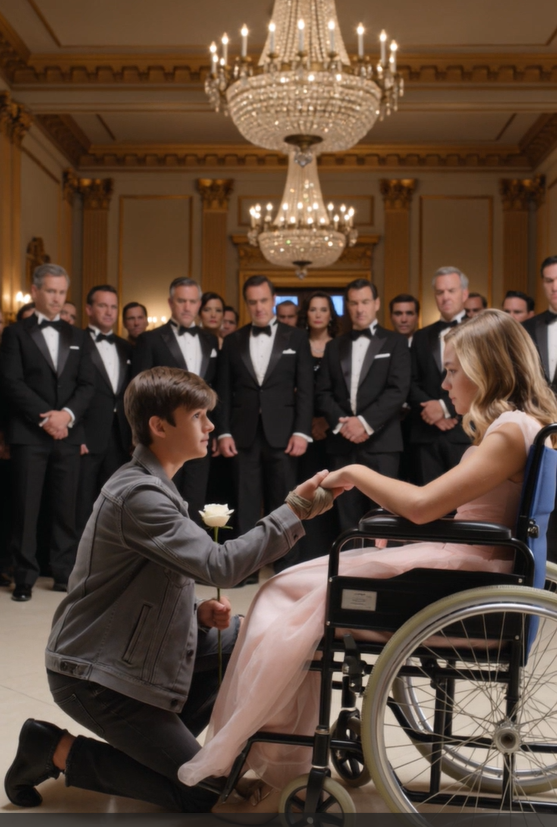
The grand ballroom fell silent so suddenly that even the soft music seemed to disappear into the crystal above. Beneath the glow of an enormous chandelier, surrounded by polished marble floors and guests dressed in silk, diamonds, and tailored black tuxedos, a poor boy in dusty clothes walked straight through the center of a world where he clearly did not belong. No one knew who he was. No one knew how he had gotten past the guarded entrance, the staff, or the long line of expensive cars outside. He carried only a single white rose in one hand, and a strip of rough cloth was wrapped around the other as though he had come from hardship rather than luxury. Conversations stopped one by one as he passed. Wealthy women turned in disbelief. Men frowned. A few guests looked offended that someone like him had dared to step into such a room. But the boy did not look at any of them. His eyes were fixed on one person alone — a blonde girl in a wheelchair, wearing a soft pink dress, seated near the center of the ballroom like the heart of the evening. When he finally reached her, he stopped, slowly lowered himself to one knee, and held the white rose toward her as if he had crossed the entire world just to place that one impossible moment at her feet.
The girl stared at him, her fingers tightening against the arms of the wheelchair. She could not have been more than sixteen, delicate and pale beneath the golden light, with eyes that already looked full of questions no one in the room could answer. Her parents stood nearby, their elegant posture breaking for the first time that night as confusion spread across their faces. The boy’s expression, however, did not change. He was calm. Certain. Almost strangely peaceful. Then, in a voice quiet enough that it should have been lost in the vast room but somehow reached every corner of it, he said, “I’ll dance with her.” A few guests let out short, nervous laughs, the kind people use when something feels too absurd to be real. The girl lowered her eyes, and for a second it seemed the weight of the room returned to her shoulders. “I can’t walk,” she whispered. Her voice trembled, not with anger, but with the exhaustion of someone who had heard too many promises before. The room remained frozen, waiting for the boy to step back, embarrassed, corrected, dismissed. But he did not move. He only stretched out his hand toward her, steady and patient, and replied with complete confidence, “I’ll make you walk.”
That was when the air in the ballroom changed. The laughter vanished. The girl’s parents exchanged a quick, frightened glance. Everyone in that room knew her story. Doctors had spent years trying to help her. Famous specialists had examined her. Therapies had failed. Money had failed. Hope itself had nearly failed. Yet this boy, in a worn gray jacket and scuffed shoes, spoke with the certainty of someone who was not guessing. The girl looked at his hand as though it frightened her more than the room did, because it carried not pressure, but possibility. Her breath caught. Very slowly, almost against her own fear, she raised her trembling fingers and placed them into his rough hand. The contrast between them was impossible to ignore — his hand worn, wrapped, and scarred by life, hers delicate and uncertain, shaped by years of being protected. A murmur passed through the crowd, then died as quickly as it came. The boy tightened his grip gently, never looking away from her face. And then the wheelchair shifted almost imperceptibly behind her.
The girl’s eyes widened. Her body tensed as though something deep inside her had awakened before her mind could understand it. One of her parents took a half-step forward, then stopped. The guests stared in disbelief. The boy rose slightly from his kneeling position, still holding her hand, guiding her not with force but with calm. For one long second nothing happened. Then another. Then, trembling violently, she began to rise. At first it was only a small lift from the seat, so slight that some thought they had imagined it. But then her shoulders straightened. Her knees locked and shook. Her pink dress trembled around her legs. The room seemed to stop breathing. She was standing. Not perfectly, not easily, but undeniably standing, supported by the hand of a stranger who had entered carrying a single white rose. Her mother covered her mouth. Her father went pale. Somewhere in the back of the ballroom, a glass slipped from someone’s fingers and shattered on the marble floor, but no one turned to look. Every eye was fixed on the impossible miracle beneath the chandelier.
What happened next stunned the room even more. The girl, still standing, stared into the boy’s face with tears gathering in her eyes, not because she feared falling, but because something in him felt familiar. The white rose slipped from his hand and landed softly at her feet. On the inside of his wrist, where the cloth had shifted, she saw a tiny birthmark shaped like a crescent — the same mark she had seen years ago in a faded photograph hidden in her mother’s drawer. Her lips parted. Her father looked as if the blood had drained from his body. And then the secret, buried for years beneath wealth, silence, and lies, rose to the surface all at once: this was not just a poor boy from nowhere. He was the child who had been taken away after the accident that destroyed two families — the one everyone had been told was gone forever. The girl began to cry, not from weakness, but from recognition. And as the ballroom stood frozen around them, every person there realized the truth at the same terrible, beautiful moment: he had not come only to make her walk. He had come back to reclaim the life that had been stolen from both of them.